
Search Phrase = setup
This page is part of the JV partner and distributor on-boarding process. This is the redirect link from the Instructional Email Sequence in Infusionsoft
The Affiliate Center is a password-protected portal that you can use to access your sales reports, redirect links, and acquire marketing resources that is provide for you in the form of Banners, Email Templates or Web Pages. The Affiliate Center will give you easy access to the tools and information they you'll to pile up those commissions!
If you haven't logged in yet to your affiliate account, follow these simple steps:
1. Access the instructional email we sent you with your login information. You should receive this email once you have completed our opt-in form with your name and email address. This email will contain your ID, Password and Referral Code which you should keep secure at all times so you don't lose access to your account.
2. Access the Affiliate Center Login in Page.

3. Just enter your login information, click the login button, and you're in!
There are three menu categories in the Affiliate Center: Home, Resources, and Reports.

In the Home section you can access your profile to update you contact information including email, phone number, address and the name of your company. You can also access the programs tab to see what commission programs you are included in and see what the products you can sell and what your commission setup is with those programs. Lastly, your commission structure can be viewed on the last tab

The resources section is where the magic happens. This is where you get the tools you need for promoting our digital products.
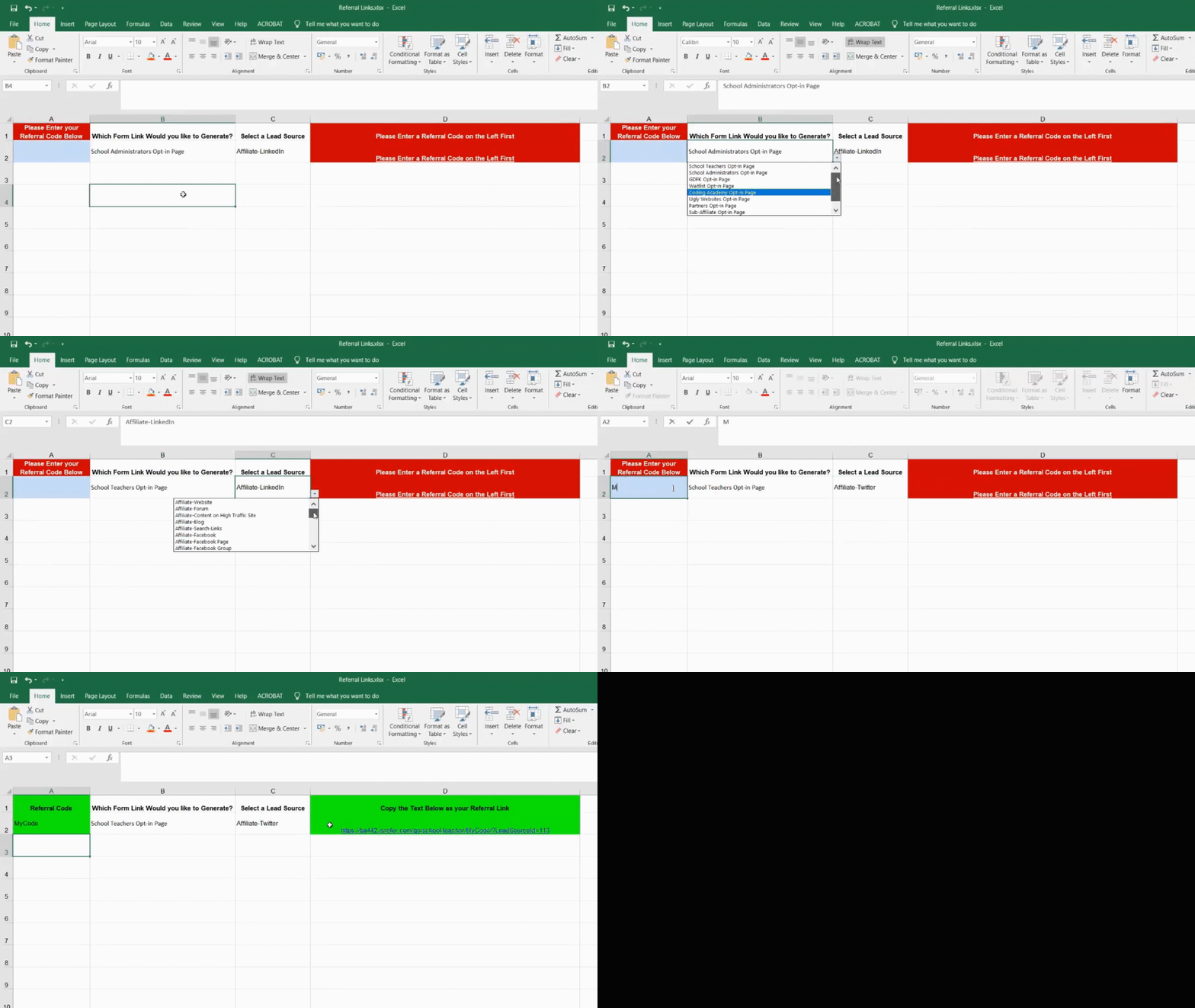
You'll need to copy and paste the links in the last column and send that to the person you want to sell to. As simple as that. That will redirect them to the Webform you have selected
Important Note: Use only these links, they are provided specifically for you. Not doing so may result in you not getting your commission.
TIP: You can use the link to wrap a button or a clickable place a page or app!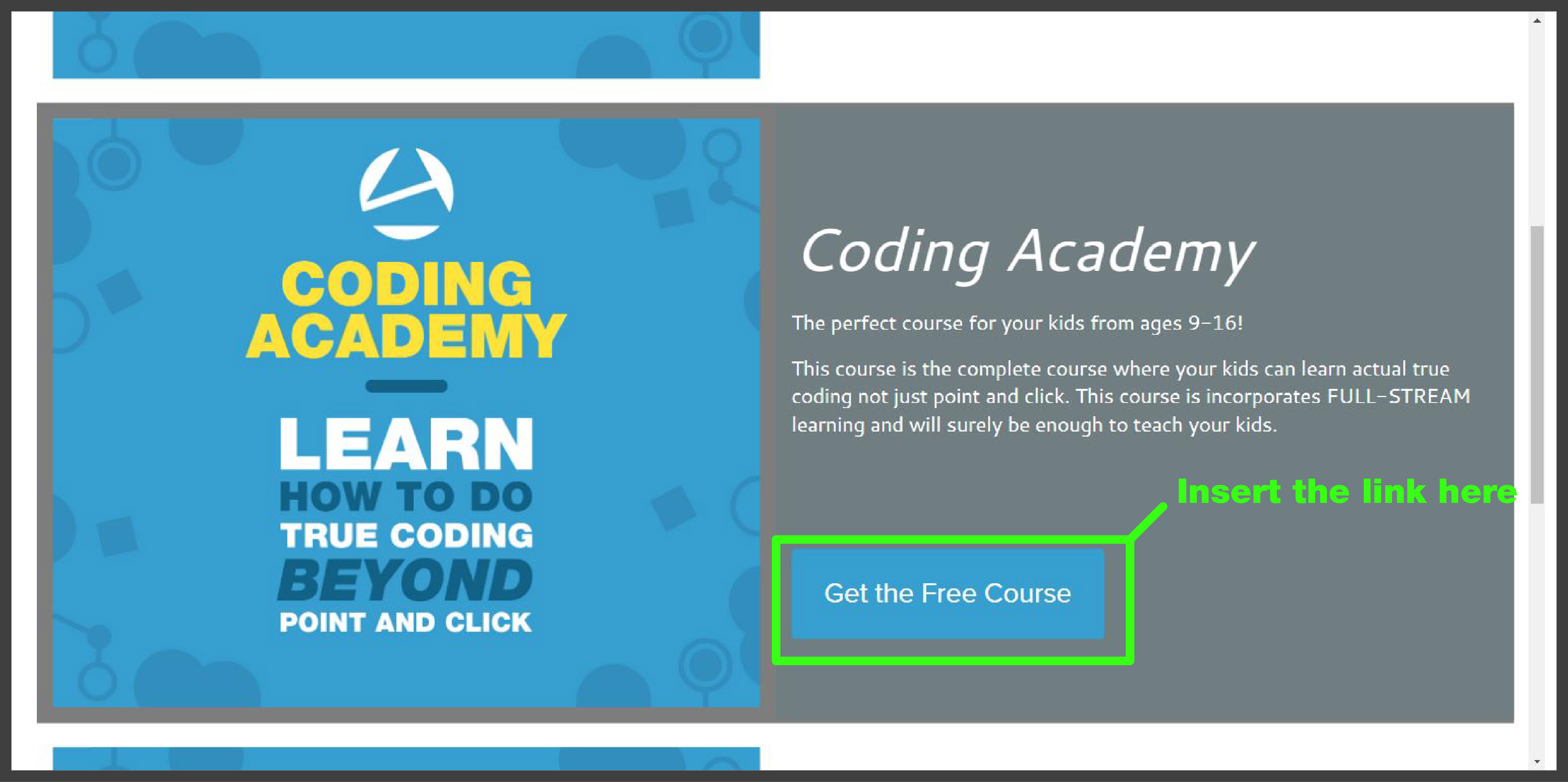

The Reports section gives you access to commission, lead tracking, and sales reports. The My Ledger report will be a valuable tool you can use to access your financial earnings.
Refine Your Program Part 1
Simple Program Example Backup
Copy and Paste the code below into your processing
function setup() { //drawing size
createCanvas(400, 400);
}
//-------------------------------------
function draw() { //this is where the drawing goes
background(220); //background color
fill("white");
ellipse(230,200,50,50); //left eyeball
fill("black"); //fill color black
ellipse(230,200,25,25); //left pupil
fill("white");
ellipse(300,200,50,50); //right eyeball
fill("black"); //fill color black
ellipse(300,200,25,25); //right pupil
}
//-------------------------------------
002b - Refine your Program Part 2
Simple Program Example Backup
Copy and Paste the code below into your processing
function setup() { //drawing size
createCanvas(400, 400);
}
//-------------------------------------
function draw() { //this is where the drawing goes
background(220); //background color
fill("white");
ellipse(230,200,50,50); //left eyeball
fill("black"); //fill color black
ellipse(230,200,25,25); //left pupil
fill("white");
ellipse(300,200,50,50); //right eyeball
fill("black"); //fill color black
ellipse(300,200,25,25); //right pupil
rect(250,300,50,50); //mouth
fill("red"); //fill color red
rect(260,339,25,25); //mouth
line(300,100,300,200);
}
Map Your Drawing On a Grid
Here are images you can import for a grid. To use these go into a new Google Doc and click Insert > Drawing > New.
Then we click the image button in the toolbar and copy and paste one of these images links into the URL field.
Advanced Grid with Numbers and Grid (Use This One)
https://drive.google.com/file/d/19JpBMvqE7wApBFjxdUGC-yddSZQbFRVK/view?usp=drive_link
Grid for Drawing - Numbers Only
https://drive.google.com/file/d/1LHgVRWY1DCCKf_kRDBQ4Onq4bcWiRNeb/view?usp=drive_link
Simple Grid
https://drive.google.com/file/d/1Ju8yjcqbfm_beCuTMpp7dlz7tNEcFlH0/view?usp=drive_link
George Example
https://drive.google.com/file/d/1-xp9eY4okCXxo_sgn72JHwrbd2GTwh7e/view?usp=drive_link
Getting Started
This introductory programming session focuses on teaching beginners how to write actual computer code using an Integrated Development Environment (IDE), specifically the Processing language. Josh Lomelino emphasizes learning programming logic and algorithms by creating computer graphics, starting with building a simple character like a robot. The approach aims to provide a lightweight, accessible entry point into programming that can be applied across multiple programming languages. By starting with practical, hands-on coding, participants will learn fundamental programming concepts while creating visual, interactive projects.
Here are the key things you will be able to do after you watch this demo:
Set up and navigate an Integrated Development Environment (IDE)
Write basic computer code using the Processing programming language
Create simple computer graphics and draw characters on screen
Understand fundamental programming logic and algorithm development
Translate programming concepts across multiple coding languages
Build foundational skills in computer graphics programming
Apply logical thinking to solve computational problems
Recognize the basic structure and syntax of a programming language
Develop a beginner's understanding of how computers interpret and execute code
Create interactive visual programs from scratch
Introduction to Programming and IDEs 0:01
Josh Lomelino emphasizes the importance of taking immediate action and introduces the concept of writing computer code from the start.
He explains the need for an Integrated Development Environment (IDE) to write and run code, highlighting its versatility in supporting various programming languages.
Josh mentions several programming languages that can be used within an IDE, including Python, Java, C++, C#, Swift, JavaScript, and even C.
He stresses that the focus will be on learning logic and creating algorithms, rather than getting bogged down in the choice of specific languages.
Building a Character and Computer Graphics 2:02
Josh announces the first project: building a character, specifically a robot, which will serve as the foundation for computer graphics.
He explains that the principles learned in this project will be applicable to various fields, from video games to animated movies.
The project aims to introduce the basics of computer graphics, which are essential for understanding more complex programming concepts.
Josh introduces the language Processing, which is based on other existing languages and will be used for the initial programming exercises.
Advantages of Processing Language 2:39
Josh highlights the benefits of using Processing, including its lightweight nature and the ability to build things quickly.
He notes that other languages may require more setup and have additional overhead, which can complicate the learning process.
Processing is chosen for its simplicity and the ease with which it can be applied to other programming languages.
The next video will cover the steps to set up an IDE and begin building logic and computer graphics programs.
Next Steps and Conclusion 3:38
Josh outlines the plan for the next video, which will focus on setting up an IDE and starting to build logic and computer graphics programs.
He reiterates the importance of understanding logic and how it can be applied to create powerful programs.
The goal is to make the computer perform cool tasks by applying logical thinking and programming concepts.
Josh concludes the session by encouraging participants to prepare for the next steps and expresses excitement for the upcoming projects.
Write your First Program
Get started with Processing by clicking here to load the editor.
Copy and paste the code below into Processing to load exactly like I show in the video above.
function setup() { createCanvas(400, 400);}
function draw() { background(220); ellipse(200,200,100,100); }

Get started with Processing by clicking here to load the editor.
Check out the student example, the Moody Ninja
Also, check out the student example, Josh's Water Bottle.
Welcome to the Coding Academy!
Unit 1 Table of Contents
Creating your first page
This demo teaches you how to quickly and easily create your first page within the CMS system. You will learn how to set up the page, including configuring the URL, description, and keywords for optimal SEO. The demo also shows you how to effortlessly add and format content, with the system automatically generating the necessary HTML tags. Finally, you will discover how to manage and modify your pages, as well as organize your content using a category-based system, empowering you to scale your website with thousands of pages.
Here are the key things you will be able to do after you watch this demo:
Log in to the CMS
Create a new content page with the title "About Us"
Specify the URL for the "About Us" page
Add a description and keywords for the "About Us" page
Enter content for the "About Us" page
Observe the automatic formatting of the content
Modify the "About Us" page content as needed
Change the URL for the "About Us" page if required
Add a link to the "About Us" page in the site map documentation
Categorize content for better organization and management
Manage large amounts of content using the centralized database
Introduction and Initial setup (0:00 - 0:30)
Explains the purpose of the demo: teaching how to create the first page
Mentions the importance of earlier steps like creating information architecture diagrams
Introduces the example pages: home, about, services, and products
URL and Description Configuration (0:30 - 1:30)
Discusses the importance of the URL for SEO and indexing
Recommends using dashes between words for better search engine visibility
Explains the flexibility of the URL and the necessity of a description for SEO
Mentions the use of keywords, both manually added and through a keyword module, and their role in SEO
Notes that advanced settings will be customized later, focusing on the basic configuration
Content Entry and Formatting (1:30 - 2:30)
Demonstrates entering content into the "about us" page
Emphasizes the ease of copying and pasting from various sources like Word or Google Docs
Highlights the automatic formatting of HTML tags for clean and well-structured code
Explains the use of semantic tags for bolding, italicizing, and other formatting
Shows how to submit the content to the database and refresh the page to see the updated content
Advanced Features and URL Management (2:30 - 3:30)
Introduces advanced features like creating headers, branding images, and integrating various media types
Explains the process of modifying and deleting pages, using the "about us" page as an example
Discusses the importance of managing URLs, including changing URLs and the potential need to relink pages
Mentions the use of related link modules for automatic URL updates and the simplicity of changing URLs without creating new records
Content Management and Categorization (3:30 - 4:30)
Demonstrates linking pages within the site map for easy navigation and content management
Explains the concept of a category-based system for managing large amounts of content
Highlights the centralized database for easy content updates and the ability to categorize content
Concludes the demo by summarizing the process of creating, viewing, and publishing the first page online, emphasizing the scalability of the system
Keywords: homepage
Home Page setup and Configuration
By following the steps demonstrated, users will be able to: Fully customize the welcome text, image sliders, and announcements on the home page to match their branding and highlight key content. They will also learn how to efficiently manage the global navigation, including creating drop-down menus and updating footer links, to establish a cohesive information architecture across their entire website. Additionally, users will gain the skills to ensure their home page layout and navigation are mobile-responsive, enabling a seamless experience for visitors on any device.
Here are the key things you will be able to do after you watch this demo:
Modify the home page welcome text to include custom content and links.
Add new image sliders to the home page and link them to specific pages.
Create and configure new announcements on the home page, including setting their order and linking to URLs.
Restructure the main navigation menu by adding new drop-down items and links.
Customize the footer navigation by removing or updating links as needed.
Modify the quick launch menu buttons on the home page to direct users to key areas.
Backup and restore the navigation structure to ensure consistency across the website.
Leverage color-coding and text editors to simplify the process of updating global navigation.
Ensure the home page layout and navigation are mobile-responsive.
Implement an organized information architecture to support growth of website content.
Customizing the Home Page Welcome Text (0:00:00)
Josh Lomelino explains the process of modifying and deleting content in the CMS to customize the home page welcome text.
He demonstrates changing the welcome text and shows how to link out to social media and add images.
Josh highlights the flexibility of the welcome text block, including the ability to link out to external websites or open images in a new window.
He mentions the ability to insert images and adjust their positioning within the welcome text block.
Configuring Home Page Sliders (0:09:03)
Josh discusses the capability of having multiple image galleries and sliders on the home page.
He explains the process of modifying or deleting content in the CMS to add or change sliders.
Josh demonstrates how to link sliders to specific pages on the website and manage images using the media manager.
He provides tips on ensuring URLs are correctly formatted and how to update sliders without issues with content delivery networks (CDNs).
Managing Home Page Announcements (0:16:05)
Josh shows how to modify and delete announcements on the home page.
He explains the process of uploading new files and linking them to specific pages.
Josh demonstrates how to set announcements to be invisible and how to order them.
He provides tips on using templates for announcements and managing image editing within AMP.
Customizing Global Navigation (0:25:44)
Josh explains the process of modifying the top navigation bar in the CMS.
He demonstrates how to create and manage drop-down menus and simple links.
Josh recommends creating backups of the navigation structure and using VS Code for easier management.
He provides tips on linking navigation items to specific pages and managing the structure of drop-down menus.
Configuring the Footer and Quick Launch Menu (0:31:25)
Josh explains how to modify the footer in the CMS, including adding links and managing the logo.
He demonstrates how to create and manage the Quick Launch menu on the home page.
Josh provides tips on ensuring the footer and Quick Launch menu are mobile responsive.
He explains the process of updating the footer and Quick Launch menu with new links and buttons.
Your End User Agreements
This demo shows how to set up the necessary legal agreements for your website, including a Terms of Service, Privacy Policy, and Cookies Policy. You'll learn how to create these pages in the CMS, customize the content, and link them throughout your website. By the end, you'll have the framework in place to automatically capture user agreement to your legal terms when they create an account or interact with your site.
Create a Privacy Policy page with the URL "/privacy-policy".
Create a Terms and Conditions page with the URL "/terms-and-conditions".
Create a Cookies Policy page with the URL "/cookies-policy".
Copy and paste the company's specific Terms of Use, Privacy Policy, and Cookies Policy content into the respective pages.
Update the login page link in the main navigation to point to the client user login page.
Setting Up Licensing Agreements in AMP (0:09)
Josh Lomelino explains the process of setting up licensing agreements, including end-user agreements, privacy policies, and cookies policies.
AMP automates the process of capturing user agreements, including timestamps when users create accounts.
Customization of Terms of Use, Privacy Policy, and Cookies Policy is necessary, often done with the help of attorneys or services like LegalZoom.
The demo focuses on how to set up these legal agreements in the AMP system.
Creating and Linking Legal Pages (1:52)
Josh demonstrates creating a new page for the Privacy Policy, Terms and Conditions, and Cookies Policy in the CMS.
Each page is given a specific URL and description, and categories can be created for better organization.
The URLs for these pages are crucial for AMP to capture user agreements automatically.
Josh shows how to link these legal pages from the login page and other relevant pages on the website.
Handling User Consent and Cookies (2:31)
Josh explains the process of capturing user consent for Terms of Service, Privacy Policy, and Cookies Policy when users create accounts.
AMP displays a timestamp of when users agree to these policies, which can be reviewed later.
For users who visit the site without creating an account, AMP displays a passive cookies notice.
Users can click "Learn More" to view the Cookies Policy, which is stored in their browser once accepted.
Setting Up Legal Document Pages (5:26)
Josh demonstrates copying and pasting legal documents into the created pages for Terms and Conditions, Privacy Policy, and Cookies Policy.
AMP formats the documents automatically, and users can manually adjust styles if needed.
The process involves submitting changes to the database to reflect the updated legal documents.
Josh emphasizes the importance of working with attorneys or legal services to craft specific legal agreements for the business.
Finalizing the setup and User Experience (10:09)
Josh updates the login page to link to the client user portal, ensuring users can access the Terms and Conditions and Privacy Policy.
Users can create new accounts and agree to the terms, with the timestamp captured in the system.
The demo covers the end-to-end process of handling user agreements and cookies policies.
Josh encourages participants to ask questions and continue building their legal agreements and user management systems.
Your DNS
This video provides a comprehensive guide on how to set up DNS and SSL/TLS configurations for a website using Cloudflare. By following the steps demonstrated, viewers will be able to configure the necessary DNS records, including an A record and a CNAME record, to properly direct traffic to the origin server and leverage Cloudflare's security features. These techniques can be applied to another CDN (content delivery network) if you are not using cloudflare.
Here are the key things you will be able to do after you watch this demo:
Configure DNS records, including an A record and a CNAME record, to direct traffic to the origin server.
Explain the purpose and benefits of enabling the "proxied" setting for DNS records to enhance security.
Differentiate between the various SSL/TLS encryption mode options (full, flexible, strict) and apply the appropriate configuration to establish a secure connection.
Evaluate SSL connections by interpreting browser security indicators and certificate details.
Recognize the option to use a custom SSL certificate branded to the domain and describe the process to deploy it on both the Cloudflare edge server and the origin server.
Collaborate with Cloudflare support to set up advanced SSL certificate configurations for specific use cases.
Demonstrate the overall process of setting up DNS and SSL/TLS for a website, including the necessary steps and considerations to ensure a secure and reliable connection.
Troubleshoot and resolve any issues that may arise during the DNS and SSL/TLS setup process.
Communicate the technical details and benefits of the implemented DNS and SSL/TLS configurations to stakeholders.
Apply the knowledge gained from this demo to set up secure and reliable web infrastructure for future projects.
Cloudflare DNS setup Instructions (0:02)
Josh Lomelino explains the need to create two records: an A record and a CNAME record to direct traffic to the anomaly amp server.
The A record should have the website name as the host and the provided IP address as the value.
Proxied should be turned on to hide the origin server's IP address, making the connection more secure.
The A record should be saved after entering the IP address.
Adding the CNAME Record (2:09)
Josh Lomelino instructs to add a CNAME record with the host set to www and the value set to the website name (e.g., www.createmedia.com).
The CNAME record ensures that www.websitename.com redirects to the main website and supports SSL.
Proxied status should be set to cloak the origin server's IP address.
The CNAME record configuration ensures that SSL is enabled for www subdomains.
Configuring SSL Settings in Cloudflare (3:21)
Josh Lomelino discusses the SSL/TLS encryption mode options: full, flexible, and strict.
Full mode ensures an SSL certificate between the user and Cloudflare, and between Cloudflare and the origin server.
Flexible mode allows SSL between the user and Cloudflare but not between Cloudflare and the origin server.
Strict mode provides the strongest SSL connection but requires testing to ensure full mode is working first.
Testing and Troubleshooting SSL Connections (6:20)
Josh Lomelino explains the process of testing SSL connections by checking the browser's security icon.
The security icon indicates whether the connection is secure and provides details about the SSL certificate.
Users can check if they are using a shared certificate or a custom certificate branded with their domain.
Most users won't need to drill down to the certificate details, but the techniques shown cover most use cases.
Advanced SSL Certificate Management (6:40)
Josh Lomelino mentions the option to purchase a custom SSL certificate for the Edge server.
High-end experiences may require deploying a custom certificate to the origin server.
Advanced support may be needed to install the custom certificate on the origin server.
Most cases don't require a custom certificate, but the option is available for enhanced security.
Final Steps and Troubleshooting Tips (8:54)
Josh Lomelino summarizes the DNS and SSL setup process, ensuring a working SSL certificate between the user and Cloudflare.
The final step is to test the setup in the browser to ensure the SSL connection is secure.
Users can check the certificate details to verify the SSL configuration.
Josh Lomelino offers to answer any questions and encourages users to reach out for further assistance.
CMS Login
This video provides an overview of the different password-protected areas within AMP and how to manage access to them. Viewers will learn how to log in to the CMS, reset passwords, and create additional user accounts with varying levels of access. By the end, viewers will be login to the CMS in order to create content, manage classes, and integrate features within the CMS to build out their AMP site.
Note that you will need to go to yoursite.com/cms/login.html in order to login. Change yoursite.com to be your site.
Use the user name that was provided to you. Note that your password must be reset the first time you use the system. To do so enter the email you signed up to AMP with and do a password reset.
Once you have reset your password you will be allowed into the CMS and you can follow the steps shown in this demo.
Here are the key things you will be able to do after you watch this demo:
Access password-protected areas within AMP
Distinguish between public and portal-protected content
Describe different types of portal-protected content (one-off pages, classes with payment requirements)
Explain how customers can log in and view authenticated content
Manage access permissions for business owners and designated users in the CMS
Navigate to the CMS login page and log in
Reset password and create additional user accounts
Maintain password security and avoid saving passwords in browsers
Create content, manage classes, and integrate features within the CMS
Discuss next steps for building out content and integrating the logo
CMS Login Overview (0:10)
Josh Lomelino explains the different types of password-protected areas within AMP, emphasizing the distinction between public and portal-protected content.
He describes the first type of content as one-off pieces that require a portal login, such as specific pages or classes that need payment before access.
The second type involves classes where all content within is locked down by login, with some classes requiring payment for access.
AMP provides various methods for customers to log in and view authenticated content based on payment or simple login requirements.
CMS Login for Business Owners and Designated Users (1:48)
Josh Lomelino introduces the CMS login, which allows business owners and designated users to access different parts of AMP.
He explains the flexibility in granting access to users, such as access to the main site, blog, or financial records, depending on the business's needs.
The customer portal provides access to financial records, payment status, past invoices, and interactions within the system.
Businesses can decide how much or little access to grant to different team members based on their roles.
Accessing the AMP CMS Login (3:32)
Josh Lomelino demonstrates how to log in to the AMP CMS login by navigating to site.com/cms/login.html.
He highlights the central dashboard that allows managing memberships, content, and the blog in one place.
The dashboard also handles marketing funnels and digital download resources, which can be linked from the main portal.
Josh explains the password reset process for initial setup and the creation of additional accounts for different access levels.
Security and Password Management (4:32)
Josh advises against saving the password in the browser for security reasons, recommending to click "never" when prompted to save the password.
He emphasizes the importance of keeping the password in a secure place to prevent unauthorized access to customer records.
The password reset process is crucial for gaining access to the admin login and managing other accounts.
Josh concludes by mentioning the next steps in building out content and integrating various features with the logo.
Keywords: Anomaly AMP, digital engagement, online presence, content management, marketing funnels, evergreen content, user experience, scalability, healthcare industry, education sector, e-commerce, social media integration, customizable templates
Welcome to AMP

Here are the top things you will be able to do when you complete this module.
Introduction to AMP

Here are the top things you will be able to do when you complete this module.
Core Components


Coming Soon

Coming Soon
Creating and Modifying Content
This demo provides a comprehensive overview of the content management capabilities within the platform. Viewers will learn how to efficiently create, customize, and publish content pages, leveraging advanced features like related links, multimedia integration, and mobile-responsive design. By the end of the session, users will be empowered to rapidly develop and manage engaging, interconnected content that can be easily shared across social media to drive audience growth and engagement.
Here are the key things you will be able to do after you watch this demo:
Create and customize content pages within the CMS, including setting URLs, descriptions, keywords, and search engine priority
Utilize advanced features like left/right panels, side menus, classes, units, folders, and categories to organize content
Manage page metadata like publishing dates, authors, and social media sharing settings
Integrate multimedia content like banners, galleries, and videos into pages
Leverage the related links functionality to build interconnected content networks
Auto-generate web-friendly HTML from external sources like Word or Google Docs
Efficiently insert and format images within content pages
Preview and validate the mobile responsiveness of content pages
Understand how to make content shareable on social media to drive engagement and traffic
Gain familiarity with the overall content management workflow and tools within the system
Creating and Modifying Content: Introduction and Initial setup (0:00)
Josh Lomelino introduces the session, focusing on creating and modifying content in the site.
He explains the process of creating a page, starting with a join page to onboard new members.
Josh demonstrates how to set URLs, descriptions, and keywords for SEO purposes.
He highlights the importance of search engine priority and the ability to create left and right panels with side menus.
Advanced Features and Customization (4:04)
Josh discusses the ability to create classes, units, folders, and categories within the content management system.
He explains the options for specifying publishing dates, authors, and displaying authorship information.
Josh demonstrates how to customize page banners, including the use of fixed and full-width headers.
He shows how to integrate social media sharing and create galleries and video content.
Social Media Integration and Keyword Visibility (4:19)
Josh explains the process of setting social media visibility and the benefits of having keywords visible for internal searches.
He demonstrates how to create a keyword cloud for users to drill down into content based on keywords.
Josh shows how to modify the join page by setting keywords to invisible and adding content about joining the membership.
He highlights the importance of making content shareable on social networks and managing social media visibility.
Rapid Development and Related Links (7:58)
Josh demonstrates how to add additional content to the join page, including related links and external resources.
He explains the power of the related link network and the ability to filter search results in real-time.
Josh shows how to link to items on the main site, blog, and external resources like Google Docs.
He explains the process of reordering items and managing external links within the system.
Auto-Generation of Content and Image Management (12:28)
Josh demonstrates how to auto-generate HTML from Word or Google Docs, maintaining web-friendly code.
He explains the process of copying and pasting content from Word, including formatting and image management.
Josh shows how to insert images, set descriptions, and format images to wrap text around them.
He highlights the ability to create sales funnels and link to e-commerce within the system.
Mobile Preview and Final Touches (18:58)
Josh explains how to preview the site on different form factors using developer tools in browsers.
He demonstrates the responsiveness of images and the ability to view the site on various devices.
Josh highlights the benefits of social media sharing and the potential for content to go viral.
He concludes by summarizing the process of creating and modifying content, emphasizing the ease of use and flexibility of the system.
File and Media Manager
The File Manager demo showcases a powerful tool for efficiently organizing and managing files of various types, including images, PDFs, and ZIP archives. Users will learn how to mirror their local file structure on the server, upload files using drag-and-drop or the upload button, and seamlessly integrate these files into web content. The demo also highlights advanced features such as image editing capabilities, folder management options, and direct file insertion into pages, empowering users to streamline their content creation and file organization workflows.
Here are the key things you will be able to do after you watch this demo:
Organize files and folders efficiently using the File Manager
Mirror local file structure on the server using drag-and-drop
Integrate various file types (images, PDFs, ZIP files) into web pages
Create a hierarchical folder structure for long-term scalability and accessibility
Upload files to the server using drag-and-drop or the upload button
Insert images into web content using the File Manager integration
Add alternate descriptions to images for improved accessibility
Link files (PDFs, ZIP archives) for users to download
Edit images directly within the File Manager using advanced tools
Save frequently accessed folders as favorites for quicker navigation
Manage folders at scale, including renaming, downloading, and zipping
Directly insert files into web content using the Insert File button
File Manager Overview and Initial setup (0:08)
Josh Lomelino introduces the File Manager component, emphasizing its power to organize files efficiently.
The File Manager allows users to mirror their local file structure on the server using drag-and-drop functionality.
Josh demonstrates the interface, showing various file types like images and PDFs that can be integrated into pages.
The File Manager is accessed through the CMS under Content Management, opening in a full-screen view for easy navigation.
Organizing Files and Folders (1:49)
Josh explains the importance of organizing files hierarchically for long-term accessibility and structure.
He creates a folder structure for assets, classes, and subfolders for headers and sliders.
Drag-and-drop functionality is used to upload images from the local file system to the server.
Josh advises against using spaces in folder names to avoid special characters in URLs.
Inserting and Managing Images (5:59)
Josh shows how to insert images into content pages using the Insert Image button.
The file structure in the File Manager is mirrored in the content management interface for easy file selection.
Drag-and-drop functionality is also available when editing content, making it flexible and efficient.
Josh emphasizes the importance of using alternate descriptions for images to improve accessibility.
Linking Files for Downloads (9:26)
Josh demonstrates how to link files for downloads, such as PDFs, by selecting text and inserting a link.
He suggests organizing files in high-level folders like classes or PDFs for better scalability.
The process involves browsing for the file in the File Manager and inserting the link into the content.
Josh highlights the importance of a clear folder structure to avoid reorganization later.
Handling ZIP Files (12:49)
Josh explains how to create and manage ZIP files using the File Manager.
He demonstrates compressing a collection of files and folders into a ZIP file on a PC.
The ZIP file can be uploaded and managed in the File Manager, with folders created for scalability.
Josh shows how to insert a link to the ZIP file in content pages, allowing users to download the file.
Advanced Image Editing Features (16:35)
Josh introduces the image editing tools available in the File Manager, including resizing, cropping, and adjusting brightness and contrast.
He demonstrates applying multiple operations to an image and saving the changes.
The File Manager supports various image editing features similar to Photoshop, making it easy to manage images without external software.
Josh highlights the ability to save favorites for frequently accessed folders to save time.
Advanced File Management Features (20:03)
Josh explains advanced options for managing folders, such as renaming, downloading, and zipping entire folders.
He demonstrates how to remove files or folders if needed.
The File Manager allows users to rename files and folders directly from the interface.
Josh mentions the Video Manager, which will be covered in another session, for managing video files at scale.
Inserting Files Directly into Content (21:34)
Josh introduces the Insert File button at the bottom of the toolbar for quickly inserting files into content.
This method allows users to place files without typing descriptive text first.
The inserted file name and link can be edited later for customization.
Josh emphasizes the flexibility of the File Manager in managing various file types and integrating them into content.
The Big View Part 2
By the end of this demo, you will be able to map out a comprehensive traffic strategy for your business. You will learn how to identify and leverage different traffic sources, like social media groups and search engines, to funnel users into your conversion funnels. Additionally, you will gain the skills to analyze your competitors' traffic strategies and apply those insights to create an actionable plan to drive traffic to your website without any upfront costs.
Visualize the internet as a pond and different traffic sources as schools of fish
Identify key traffic sources like Facebook groups, Twitter, YouTube, and search engines
Map out a customer journey and traffic architecture to funnel users to conversion pages
Develop a strategy to "fish" for users in different traffic sources using a lead magnet
Analyze competitor traffic strategies and funnels to learn and leverage their marketing efforts
Create an actionable plan to implement a traffic strategy without spending money upfront
Automate strategies based on insights from competitor analysis
Execute on a planned traffic strategy and conversion optimization approach
Understanding Customer Journey and Traffic Sources (0:08)
Josh Lomelino emphasizes the importance of mapping out the customer journey and understanding how users find competitors.
He uses the analogy of the internet as a pond to visualize different traffic sources and user groups.
Examples of traffic sources include Facebook groups, Twitter, and YouTube, each attracting users with specific interests.
The goal is to attract users from these sources into the company's funnel and then focus on conversion strategies.
Visualizing Traffic and Conversion Strategies (3:21)
Josh explains the concept of "fishing" in the internet pond, where the company places its "bait" to attract users to their website.
He discusses various traffic sources like Google and Bing searches, aiming to capture and direct traffic to the company's website.
The strategy involves developing a plan for each type of traffic to create a comprehensive traffic strategy.
The first step is to create a journey map to understand all available traffic sources and map out the architecture for each.
Developing a Traffic Strategy Framework (4:38)
Josh introduces the concept of a traffic strategy framework, which includes creating a journey map and mapping out the architecture.
He suggests that the strategy can be developed on pencil and paper if not using a fancy diagram.
The focus is on identifying where users are hanging out (traffic sources) and developing a strategy to funnel them to conversion pages.
Conversion pages, also known as squeeze pages, are highly focused on converting traffic into leads or customers.
Implementing the Traffic Strategy (6:24)
Josh shares an example of a marketing funnel planning for a university, focusing on finding and bringing users into the funnel.
The strategy includes identifying main traffic sources like Facebook, LinkedIn, YouTube, word of mouth, blogs, and Pay Per Click advertising.
The approach is to focus on one to three traffic sources initially and then introduce additional sources gradually.
The goal is to build an ecosystem that leverages traffic effectively, bringing everything back to a central hub for scalable and leveraged growth.
Leveraging Competitor Strategies (10:11)
Josh discusses the importance of analyzing top competitors' traffic strategies to learn and leverage their marketing dollars.
The next session will focus on breaking down competitors' traffic setups and automating strategies to use their insights.
The goal is to create an actionable plan without spending any money, relying on planning and execution.
The strategy aims to provide actionable insights and a plan to execute, leveraging competitor strategies to improve the company's approach.
Where Is Your Audience Hanging Out?
After watching this demo, you will be able to visualize your online traffic as a metaphorical "pond" and strategically "fish" for your target customers in the right traffic sources. You will learn how to map out a comprehensive traffic architecture that funnels users from various platforms like social media and search engines into your conversion funnels. Additionally, you will gain the skills to analyze your competitors' traffic strategies and leverage those insights to create an actionable, cost-effective plan to drive more traffic to your own website.
Analyze competitors' marketing strategies and identify what is working for them.
Determine where the target audience is "hanging out" online and in their daily lives.
Develop a plan to strategically insert the product or service into the audience's daily traffic patterns.
Compile a comprehensive list of 20-30 potential free traffic sources, including blogs, forums, podcasts, and social media groups.
Identify 20-25 influential people within the target market who can promote the product or service to their audience.
Research top-selling products and customer reviews related to the product or service offering.
Organize all research findings into a structured spreadsheet for ongoing analysis and action planning.
Rank the identified traffic sources by relevance to prioritize lead magnet and free resource placements.
Implement the traffic strategy by leveraging the highest-ranked free traffic sources.
Monitor results and iterate the traffic strategy based on performance data.
Understanding Customer Journey and Traffic Sources (0:08)
Josh Lomelino emphasizes the importance of mapping out the customer journey and understanding how users find competitors.
He uses the analogy of the internet as a pond to visualize different traffic sources and user groups.
Examples of traffic sources include Facebook groups, Twitter, and YouTube, each attracting users with specific interests.
The goal is to attract users from these sources into the company's funnel and then focus on conversion strategies.
Visualizing Traffic and Conversion Strategies (3:21)
Josh explains the concept of "fishing" in the internet pond, where the company places its "bait" to attract users to their website.
He discusses various traffic sources like Google and Bing searches, aiming to capture and direct traffic to the company's website.
The strategy involves developing a plan for each type of traffic to create a comprehensive traffic strategy.
The first step is to create a journey map to understand all available traffic sources and map out the architecture for each.
Developing a Traffic Strategy Framework (4:38)
Josh introduces the concept of a traffic strategy framework, which includes creating a journey map and mapping out the architecture.
He suggests that the strategy can be developed on pencil and paper if not using a fancy diagram.
The focus is on identifying where users are hanging out (traffic sources) and developing a strategy to funnel them to conversion pages.
Conversion pages, also known as squeeze pages, are highly focused on converting traffic into leads or customers.
Implementing the Traffic Strategy (6:24)
Josh shares an example of a marketing funnel planning for a university, focusing on finding and bringing users into the funnel.
The strategy includes identifying main traffic sources like Facebook, LinkedIn, YouTube, word of mouth, blogs, and Pay Per Click advertising.
The approach is to focus on one to three traffic sources initially and then introduce additional sources gradually.
The goal is to build an ecosystem that leverages traffic effectively, bringing everything back to a central hub for scalable and leveraged growth.
Leveraging Competitor Strategies (10:11)
Josh discusses the importance of analyzing top competitors' traffic strategies to learn and leverage their marketing dollars.
The next session will focus on breaking down competitors' traffic setups and automating strategies to use their insights.
The goal is to create an actionable plan without spending any money, relying on planning and execution.
The strategy aims to provide actionable insights and a plan to execute, leveraging competitor strategies to improve the company's approach.
Keywords: variables
Variables Overview Part 1
Variables Overview Part 1
Click here to load this code in the P5JS Editor
Or Copy/Paste the code below into your own P5JS Editor
function setup() { createCanvas(600, 600);
drawBox(0, 0, 30, 500); // function call to drawBox}
function drawBox(a, b, c, d) { // Draw a rectangle using the given parameters. rect(a, b, c, d);}
Variables Overview Part 2
Variables Overview Part 2
Below is the full source code from this demo. You can copy and paste this into P5JS or you can open it directly here.
function setup() {
createCanvas(500, 500); myXPos = 200; console.log("I am in the setup function an myXPos = " + myXPos); fill("blue"); drawBox(myXPos, 200, 50, 70); fill("red"); drawBox(myXPos+100, 0, 200, 500);}
function drawBox (a,b,c,d) { console.log ("I am in the drawBox function and myXPos = " + a); rect(a,b,c,d); }
Variables Overview Part 3
Below is the full source code from this demo. You can copy and paste this into P5JS or you can open it directly here.
function setup() {
createCanvas(500, 500); myXPos = 200; console.log("I am in the setup function an myXPos = " + myXPos); fill("blue"); drawBox(myXPos, 200, 50, 70); fill("red"); drawBox(myXPos+100, 0, 200, 500);}
function drawBox (a,b,c,d) { console.log ("I am in the drawBox function and myXPos = " + a); rect(a,b,c,d); }
Initial Drawing Factory setup
Initial Drawing Factory setup
Click here to load the live code in P5JS
Or you can copy and paste the code below into your own P5JS
function setup() { createCanvas(600, 600); drawsetup();}
function draw() { // Empty draw loop – all drawing is done in drawsetup()}
function drawsetup() { console.log("I am in the drawsetup function!");
// setup configuration for drawsetup background('#FFFFCD'); strokeWeight(5); rectMode(CORNER);
let xPosition = 50; let yPosition = 50; let shapeWidth = 300; let shapeHeight = 300; let shapeColor = "8,129,249"; let shapeOutline = "5,6,7";
// Currently, shapeColor and shapeOutline are not used. You can add logic to apply these if needed. rect(xPosition, yPosition, shapeWidth, shapeHeight);}
Drawing Factory Part 2
Drawing Factory Part 2
Click here to load the code live in P5JS
Code you can copy/paste below
function setup() { createCanvas(600, 600); drawsetup();}
function draw() { // Empty draw loop – p5.js will loop this continuously}
function drawsetup() { console.log("I am in the drawsetup function!");
background('#FFFFCD'); strokeWeight(5); rectMode(CORNER);
// Data let xPosition = 50; let yPosition = 50; let shapeWidth = 50; let shapeHeight = 50; let shapeColor = "8,129,249"; let shapeOutline = "5,6,7";
// Call the drawShape function drawShape(xPosition, yPosition, shapeWidth, shapeHeight, shapeColor, shapeOutline); drawShape(xPosition, yPosition, shapeWidth, shapeHeight, shapeColor, shapeOutline);}
function drawShape(xPOS, yPOS, shapeWidth, shapeHeight, shapeColor, shapeOutline) { console.log("I am in the drawShape function and xPOS = " + xPOS);
// Currently, shapeColor and shapeOutline are not used for drawing. // You can add code here to use these parameters if needed.
rect(xPOS, yPOS, shapeWidth, shapeHeight);}
Randomization Part 1
Randomization Part 1
Click here to load the P5JS editor with this program.
Here is the source code you can copy and paste into your P5JS Editor. Or you can preview it below.
function setup() { createCanvas(600, 600); drawsetup();}
function draw() { // Empty draw loop – waiting for user interaction or further drawing}
function drawsetup() { console.log("I am in the drawsetup function!");
// setup configuration for drawsetup background('#FFFFCD'); strokeWeight(5); stroke('#6e6e6e'); let numOfShapes = 50; // the number of shapes to draw
// Create randomly placed circles on the canvas with randomized RGB values / alpha values // (loop body not shown in the Processing code) for (let i = 0; i < numOfShapes; i++) { // (Add code here if needed) }
// Data let xPosition = 50; let yPosition = 50; let shapeWidth = 50; let shapeHeight = 50; let shapeColor = "8,129,249"; let shapeOutline = "5,6,7";
// Function calls - send arguments drawShape(xPosition, yPosition, shapeWidth, shapeHeight, shapeColor, shapeOutline); drawShape(xPosition + 20, yPosition + 20, shapeWidth + 20, shapeHeight + 20, shapeColor, shapeOutline);}
function drawShape(xPOS, yPOS, shapeWidth, shapeHeight, shapeColor, shapeOutline) { console.log("I am in the drawShape function! and xPOS = " + xPOS); // Currently, shapeColor and shapeOutline are not used in this function. // You can add code to utilize these parameters if needed. rect(xPOS, yPOS, shapeWidth, shapeHeight);}
Keywords: Content,creation,workflow,time-saving,high-quality,student,outcomes,audio,file,screen,recording,Camtasia,OBS,generative,AI,digital,double,course,matrix,instructional,design,Otter,PowerPoint,slides
Josh Lomelino's ultimate content creation workflow is designed to dramatically reduce course development time from months to weeks or days by leveraging various content generation methods. His approach ranges from simple audio-only techniques to fully automated workflows using generative AI, with a focus on delivering clear, measurable learning outcomes. The workflow encompasses four progressive methods, starting with basic audio creation and advancing to complex AI-driven content generation that can produce digital avatars, slides, and video content from simple text prompts. By providing a flexible, scalable approach, Lomelino enables content creators to efficiently develop high-quality online courses and educational materials.
Josh Lomelino's ultimate content creation workflow is designed to dramatically reduce course development time from months to weeks or days by leveraging various content generation methods. His approach ranges from simple audio-only techniques to fully automated workflows using generative AI, with a focus on delivering clear, measurable learning outcomes. The workflow encompasses four progressive methods, starting with basic audio creation and advancing to complex AI-driven content generation that can produce digital avatars, slides, and video content from simple text prompts. By providing a flexible, scalable approach, Lomelino enables content creators to efficiently develop high-quality online courses and educational materials.
After this demo, learners will be able to:
Understand the Four Methods of Content Creation
Differentiate between audio-only, screen recording, webcam, and fully automated content generation techniques
Recognize the strengths and limitations of each workflow method
Develop Efficient Content Generation Skills
Apply AI tools like Otter AI, Claude AI, and ChatGPT for script drafting and refinement
Create high-quality educational content using streamlined workflows
Leverage AI Technologies for Course Development
Utilize generative AI platforms for audio, video, and slide creation
Transform content development timelines from months to weeks
Design Learner-Centered Educational Content
Craft clear, measurable learning outcomes
Develop instructional materials that focus on practical skills and immediate application
Implement Scalable Content Production Strategies
Overview of Content Creation Workflow 0:09
Josh Lomelino introduces the ultimate content creation workflow class, aiming to reduce course development time from months to weeks or days.
The course will cover a blend of simple to fully automated workflows, starting with simpler methods for quick wins and progressing to advanced approaches.
Emphasis is placed on delivering clear, measurable outcomes and setting up necessary systems from the start.
The course will cover creating basic audio files, screen recording using tools like Camtasia or OBS, and fully automated workflows using generative AI.
Methods of Content Creation 1:30
Josh Lomelino outlines four methods of content creation, ranging from simple to fully automated, with each method providing a different level of complexity and automation.
Method one involves creating audio-only content using tools like Claude AI or ChatGPT to refine scripts and generate final audio files.
Method two involves real-time screen recording using software like Camtasia, capturing both screen content and voice simultaneously.
Method three combines screen recording with live webcam footage, allowing for a more dynamic on-screen presence.
Method four uses AI to generate a digital double video from a recorded vocal track, with AI also generating PowerPoint or Canvas slides.
Detailed Explanation of Methods 2:49
Method one: Josh explains the process of refining raw text into final audio scripts using AI tools and recording the final audio file manually or with AI.
Method two: Josh describes using Camtasia to record both screen and voice simultaneously, minimizing post-production work and suitable for relaxed, adaptable work.
Method three: Josh details recording both screen and webcam footage in one take, requiring careful setup for a consistent on-camera presence.
Method four: Josh explains using AI to generate a digital double video from a recorded vocal track, with AI also generating slides synchronized to the transcript.
Implementation and Integration 10:04
Josh emphasizes the importance of starting with method one and progressing sequentially to method four, explaining the workflows and specific tools used to optimize the process.
The course is designed to provide strategies that can be implemented immediately, with each method providing a different level of automation and complexity.
Josh will demonstrate how to generate scripts, auto-generate audio files, and record both audio and video manually, as well as how to automatically generate PowerPoint and Canvas slides using AI.
The final video will show how to integrate these workflows into Anomaly AMP, providing learners with contextual information and a timeline breakdown.
Keywords: audio,recording,microphone,quality,live,studio,interface,phantom,power,sample,rate,uncompressed,format,pop,filter,level,balancing,Camtasia,Studio,file,organization,voice,clone,AI,avatar,sound,absorption
This video provides a comprehensive guide to professional audio recording for content creators, focusing on essential equipment and techniques for high-quality sound production. Viewers will learn how to select the right microphone, set up a proper recording environment, and use audio interfaces and editing tools to capture clean, professional-grade audio. By following Josh Lomelino's expert advice, participants will be able to create polished audio recordings suitable for workshops, demos, podcasts, and even AI-generated video content. The tutorial equips creators with practical skills to improve their audio recording process and produce more engaging, professional-sounding content.
This video provides a comprehensive guide to professional audio recording for content creators, focusing on essential equipment and techniques for high-quality sound production. Viewers will learn how to select the right microphone, set up a proper recording environment, and use audio interfaces and editing tools to capture clean, professional-grade audio. By following Josh Lomelino's expert advice, participants will be able to create polished audio recordings suitable for workshops, demos, podcasts, and even AI-generated video content. The tutorial equips creators with practical skills to improve their audio recording process and produce more engaging, professional-sounding content.
Here are the key things you will be able to do after you watch this demo:
Select an appropriate high-quality microphone for professional audio recording
Set up a clean, noise-free recording environment
Configure audio interfaces and software for optimal sound capture
Choose the correct sample rate and recording format
Use a pop filter and mic positioning techniques to improve audio quality
Perform audio test recordings and evaluate sound levels
Utilize audio editing tools for recording and post-production
Implement file organization strategies for audio projects
Export audio files in various formats for different content needs
Create consistent, professional-grade audio recordings for workshops, demos, and presentations
Prepare audio recordings for potential AI avatar or voice clone generation
Troubleshoot common audio recording and equipment setup challenges
Basic Method of Production 0:09
Josh Lomelino explains the simplicity and power of recording thoughts and ideas using just a microphone.
Live recordings during workshops or demos are more engaging but harder to edit if mistakes are made.
Studio recordings allow for pauses and polished takes but require maintaining a natural and conversational tone.
The importance of a high-quality microphone and a quiet, clean recording space is emphasized.
Microphone setup and Recording Quality 1:31
Josh recommends the AKG condenser mic for its clean, detailed sound, which requires phantom power.
The Shure 57 microphone is mentioned as a versatile option for various recording situations.
The Zoom H6 USB audio interface is preferred for its compatibility with various software like Camtasia.
Recording at 48,000 Hz instead of the default 44.1 Hz is suggested to preserve audio detail.
Audio Recording Practices 3:18
Josh advises recording in an uncompressed format like WAV until the final export to avoid audio degradation.
Ensuring the computer and audio interface are set to the same sample rate prevents speed mismatches.
The use of a pop filter and an adjustable mic arm helps maintain consistent audio quality.
Test recordings and listening on different devices help ensure balanced sound levels.
Audio Editing and Tools 4:53
Josh mentions various audio editing tools like Audacity, Adobe Audition, Pro Tools, and FL Studio.
Camtasia Studio is recommended for its convenience in recording and managing audio projects.
The Auto Normalize feature in Camtasia helps maintain consistent volume throughout recordings.
Exporting recordings as MP3s allows for generating on-camera videos using AI avatars.
File Organization and Studio setup 5:55
A consistent naming system for recordings and exports is crucial for easy retrieval and updates.
Avoiding rooms with echo and using soft materials to absorb sound helps improve recording quality.
A good studio setup, including soundproofing and proper equipment, is essential for high-quality recordings.
Josh hints at a future demo on creating a voice clone, which requires clean and consistent audio recordings.
In this video, Josh Lomelino demonstrates how to create an AI-powered digital voice replica using 11 Labs, enabling content creators to rapidly generate high-quality audio and video content at scale. By training the system with a consistent audio sample, users can produce automated voice performances that sound like their own, allowing them to create lectures, demos, and other content quickly and efficiently. The method involves uploading 1-3 hours of controlled audio recordings, fine-tuning voice settings, and integrating with platforms like HeyGen to automate video production. After watching this tutorial, viewers will be able to develop their own AI voice clone, streamline content creation, and overcome time constraints by generating multiple scripts and videos with minimal manual effort.
In this video, Josh Lomelino demonstrates how to create an AI-powered digital voice replica using 11 Labs, enabling content creators to rapidly generate high-quality audio and video content at scale. By training the system with a consistent audio sample, users can produce automated voice performances that sound like their own, allowing them to create lectures, demos, and other content quickly and efficiently. The method involves uploading 1-3 hours of controlled audio recordings, fine-tuning voice settings, and integrating with platforms like HeyGen to automate video production. After watching this tutorial, viewers will be able to develop their own AI voice clone, streamline content creation, and overcome time constraints by generating multiple scripts and videos with minimal manual effort.
Here are the key things you will be able to do after you watch this demo:
Train an AI voice synthesis system using personal audio recordings
Generate consistent voice replicas with controlled audio samples
Optimize AI-generated voice settings for natural-sounding output
Integrate voice cloning technology with video production platforms
Create automated content at scale using text-to-speech technologies
Manage AI voice generation credits efficiently
Export and store audio files in multiple formats for different applications
Prototype and refine scripts using AI voice technology
Develop a workflow for rapid content creation across lectures, demos, and presentations
Leverage AI tools to overcome time constraints in content production
Creating a Voice Replica Using AI 0:09
Josh Lomelino discusses the use of AI-powered voice synthesis to create a voice replica, emphasizing the challenge of matching human recordings.
He highlights the effectiveness of using text prompts to quickly prototype, test, and revise scripts or generate finished audio files.
Josh mentions his preference for the 11 labs tool, which offers a studio mode for producing longer form audio tracks.
He shares his initial struggles with the tool and how contacting their support provided helpful suggestions.
Training the System for Consistent Output 1:24
Josh explains the importance of training the system with a consistent audio sample to avoid unnatural variations in volume and tone.
He describes his initial mistake of using diverse recordings from different sessions, which led to inconsistent results.
Josh emphasizes the need for a controlled environment with a single, consistent audio sample for better results.
He plans to demonstrate the settings that produce the best results for replicating his voice in the user interface.
Optimizing Generated Audio Files 2:56
Josh advises generating audio sparingly to avoid exhausting monthly credits and recommends starting with smaller sections of text.
He explains the process of refining the output and generating both wave and mp3 audio files for different applications.
Josh mentions the importance of storing both wave and mp3 files for secure storage and project organization.
He notes that it may take several attempts to develop a method that works well for the user.
Exporting and Integrating Audio Files 4:19
Josh describes two methods for uploading audio files to virtual avatars: exporting both wave and mp3 versions or integrating the 11 labs API directly with Hey Gen.
He prefers using the wave audio file for higher quality and to avoid double compression but acknowledges the need to export the mp3 format for larger tracks.
Josh explains the integration of the 11 labs API with Hey Gen, which allows for rapid development of prototypes and large volumes of content.
He mentions the need to break up scripts into manageable sections for efficient processing by the software.
Automating Video Production with AI 6:02
Josh discusses the ability to produce videos at scale by automating both audio and video avatars from text.
He highlights the productivity gains from using AI to generate video scripts and produce audio and video automatically.
Josh notes the cost of AI-generated voice and the strategy of using high-quality audio only when necessary.
He explains the use of draft versions of scripts with Hey Gen's voice replica to refine the script without incurring additional costs.
Finalizing and Exporting Scripts 8:04
Josh describes the process of finalizing scripts and either reading and recording them manually or using the 11 labs integration within Hey Gen.
He mentions the use of a side-by-side display setup with a Google document and video avatar performance for quick edits.
Josh emphasizes the usefulness of this method for high-end projects that require detailed polishing and iteration.
He concludes the demo by encouraging the use of digital voice replicas to scale beyond time constraints and improve productivity.
Keywords: Screen,recording,audio,capture,on-camera,presentation,production,challenges,lighting,consistency,studio,lights,color,temperature,LED,panels,backlights,kicker,light,digital,double,4K,webcam,system,performance,green,screen,Camtasia
In this video, Josh Lomelino demonstrates Method Three for creating engaging screen recordings that combine on-camera presence, screen capture, and audio. Viewers will learn how to set up professional lighting using LED panels, choose the right camera equipment, and optimize their recording environment for high-quality video production. The tutorial covers essential techniques for maintaining visual continuity, managing lighting color temperatures, and using tools like Camtasia and green screens to create polished, professional-looking video content. By following Josh's guidance, content creators will be able to produce dynamic, natural-looking screen recordings with improved technical quality and visual appeal.
In this video, Josh Lomelino demonstrates Method Three for creating engaging screen recordings that combine on-camera presence, screen capture, and audio. Viewers will learn how to set up professional lighting using LED panels, choose the right camera equipment, and optimize their recording environment for high-quality video production. The tutorial covers essential techniques for maintaining visual continuity, managing lighting color temperatures, and using tools like Camtasia and green screens to create polished, professional-looking video content. By following Josh's guidance, content creators will be able to produce dynamic, natural-looking screen recordings with improved technical quality and visual appeal.
Here are the key things you will be able to do after you watch this demo:
Manage on-camera and screen recording simultaneously
Maintain visual continuity during video recordings
Set up professional lighting using LED panels
Adjust color temperature and brightness for optimal video quality
Create a three-point lighting setup with key, fill, and kicker lights
Select and configure appropriate camera equipment for video production
Optimize system performance for screen and camera recording
Use a Wacom tablet for digital whiteboarding
Implement green screen techniques for background removal
Combine multiple video takes into a seamless recording
Export and render high-quality video files
Create digital double avatars for reusable content
Troubleshoot common video production challenges
Select and position lighting equipment safely
Integrate on-camera performance with slides and screen recordings
Method Three Demo and Challenges 0:08
Josh Lomelino introduces method three, which involves screen recording, audio, and on-camera capture, emphasizing its ability to capture natural, unscripted moments.
He highlights the challenges of managing both screen and camera presence simultaneously, including the need to maintain a consistent camera angle and expression.
Josh explains the importance of resuming recording with a neutral expression to ensure visual continuity.
He mentions the difficulty of pausing and resuming recording without noticeable edits when on camera.
Lighting Considerations for On-Camera Work 1:46
Josh discusses the significance of lighting in on-camera work, including the need to keep lighting consistent between takes.
He recommends using affordable studio lights, such as LED lights, which stay cool and are suitable for longer sessions.
Josh explains the concept of color temperature, noting that outdoor light can affect indoor lighting and cause color shifts.
He suggests using LED lights that allow adjustments in brightness and color temperature to manage lighting effectively.
Setting Up Lighting Equipment 3:02
Josh shares his preference for the Spectro Essential 360 LED panels, which range from 3250 to 6000 Kelvins and are dimmable.
He describes his typical setup, which includes stacking four LED panels in front and sometimes behind him to create soft, even light.
Josh emphasizes the importance of using back lights to create a "kicker light" effect, which helps outline the subject and makes them stand out from the background.
He advises adding weight to light stands to prevent them from tipping if bumped.
Camera and Recording Equipment 6:07
Josh talks about using a full-frame camera like the Canon 5D Mark III for high-quality recordings, but notes that a good 4K webcam can also deliver excellent results.
He recommends Logitech webcams, such as the Logitech 1080P cam, for their affordability and performance.
Josh explains the benefits of recording screen and camera separately, especially if the system can't handle 4K video and screen capture simultaneously.
He mentions the use of digital double avatars for reusing lighting and performance footage.
Optimizing System Performance and Audio Settings 8:15
Josh advises optimizing the graphics card and operating system for better system performance.
He recommends setting the microphone to 48,000 hertz and ensuring phantom power is turned on through the sound interface.
Josh suggests using a Wacom tablet for live whiteboarding, either with the Cintiq for direct drawing or a more affordable tablet for drawing on a pad.
He emphasizes the importance of setting pen lines thick enough to show clearly in high-resolution recordings.
Using Camtasia and Green Screens 9:20
Josh highlights Camtasia's ability to combine multiple takes into one smooth recording and overlay on-camera performance videos on PowerPoint slides.
He explains the use of green screens for added flexibility, including the need to light the green screen evenly and separately from the face lighting.
Josh mentions the built-in removal tool in Camtasia for easily removing the green screen background.
He advises fine-tuning the green screen setup to avoid issues with hair and shoulder edges.
Exporting and Backing Up Videos 10:17
Josh recommends exporting videos as MP4 files using the H.264 format with a rendering quality around 75%.
He advises keeping files organized and backed up for potential updates.
Josh mentions the use of green screens for recording digital double avatar videos, which can be easily removed from the background later.
He concludes the demo by encouraging viewers to invest in high-quality audio and video assets for better results.
This video teaches how to create professional webcam performances using a free web-based teleprompter and simple recording techniques. Viewers will learn to set up a streamlined recording environment using their computer, webcam, and an online teleprompter tool, allowing them to deliver precise scripts with natural, direct-to-camera presence. The technique eliminates complex equipment setups, enabling content creators to record high-quality videos quickly and easily. By following these methods, users can improve their on-camera delivery, reduce editing time, and create polished video content with minimal technical barriers.
This video teaches how to create professional webcam performances using a free web-based teleprompter and simple recording techniques. Viewers will learn to set up a streamlined recording environment using their computer, webcam, and an online teleprompter tool, allowing them to deliver precise scripts with natural, direct-to-camera presence. The technique eliminates complex equipment setups, enabling content creators to record high-quality videos quickly and easily. By following these methods, users can improve their on-camera delivery, reduce editing time, and create polished video content with minimal technical barriers.
Here are the key things you will be able to do after you watch this demo:
Configure a webcam-based teleprompter setup
Position a teleprompter text for optimal eye contact with the camera
Use a free browser-based teleprompter tool
Record professional-looking webcam presentations
Manually scroll or auto-advance teleprompter text
Pause and resume recording seamlessly
Use green screen techniques for background removal
Deliver a natural, conversational on-camera performance
Create presentations using minimal script editing
Optimize webcam software settings for better video quality
• Introduction to webcam performances with teleprompter [0:00]
• Key Benefits of Teleprompter: [2:30]
- Delivers precise script
- Minimizes recording takes
- Ensures message clarity
• Technical setup: [4:15]
- Use Camtasia for recording
- Position free browser-based teleprompter above camera lens
- Manually scroll or use automatic text advancement
- Use F9 key for pausing/resuming recording
• Advanced Techniques: [5:30]
- Record in front of green screen
- Potential for layered recordings
- Option to use OneNote for on-screen drawings
• Performance Tips: [6:15]
- Use bullet points for natural delivery
- Avoid word-for-word scripting
- Maintain conversational tone
• Closing Recommendations: [6:45]
- Configure webcam software settings
- Prepare for future demos on camera settings
Keywords: Webcam,DSLR,setup,brightness,contrast,color,temperature,LUT,presets,image,quality,white,balancing,Logitech,software,post,production,Camtasia,Premiere,Pro,Lumetri,video,on-camera,performance
In this video, Josh provides a comprehensive guide to improving on-camera video quality using webcam settings and post-production techniques. Viewers will learn how to optimize their camera's brightness, contrast, and color settings through software applications like Logitech's control panel, and understand the importance of proper lighting and white balancing. The tutorial demonstrates how to fine-tune video appearance by adjusting settings, testing variations, and using LUT presets in editing software like Premiere Pro. By following these steps, content creators can produce professional-looking videos with consistent, high-quality visual performance.
In this video, Josh provides a comprehensive guide to improving on-camera video quality using webcam settings and post-production techniques. Viewers will learn how to optimize their camera's brightness, contrast, and color settings through software applications like Logitech's control panel, and understand the importance of proper lighting and white balancing. The tutorial demonstrates how to fine-tune video appearance by adjusting settings, testing variations, and using LUT presets in editing software like Premiere Pro. By following these steps, content creators can produce professional-looking videos with consistent, high-quality visual performance.
Here are the key things you will be able to do after you watch this demo:
Calibrate webcam settings for optimal image quality
Adjust brightness and contrast using manufacturer-specific software
Perform white balance corrections using neutral objects
Identify and correct color temperature issues
Screenshot and test video settings across multiple devices
Apply LUT presets for consistent color grading
Use post-production tools like Premiere Pro for video enhancement
Create repeatable video quality settings for future productions
Troubleshoot common on-camera video performance problems
Compare and evaluate video quality against professional standards
Critical Considerations for On-Camera Video Performances 0:08
Josh Lomelino introduces the topic of critical considerations for on-camera video performances and video quality.
He emphasizes the importance of using either a webcam or a DSLR setup, each requiring different strategies but relying on the same basic principles.
Key settings like brightness, contrast, color, and temperature are highlighted as essential for managing video quality.
LUT presets are mentioned as a tool for applying color adjustments quickly and consistently in post-production.
Focus on Webcam Use Case 0:51
Josh Lomelino explains that he will primarily focus on the webcam use case, as it is likely the dominant form of production for most people.
He discusses the benefits of using specific software applications for webcams, such as Logitech, to manage image quality settings.
The Logitech settings control panel is used as an example to demonstrate managing all aspects of the image, starting with brightness adjustments.
Josh emphasizes the importance of setting up the environment and lighting properly to minimize ongoing adjustments.
White Balancing and Color Adjustments 2:28
Josh explains the process of white balancing, using neutral objects like teeth or a white piece of paper to calibrate the camera.
He advises adjusting brightness, contrast, and color settings, and suggests testing variations by screenshotting or recording short clips.
He shares a personal anecdote about a time when his video looked off due to incorrect white balancing, leading to concerns about his health.
The importance of locking in settings, screenshotting results, and storing them for future reference is emphasized.
Post-Production Adjustments 4:06
Josh discusses the use of post-production tools like Camtasia and Premiere Pro for making quick adjustments if the video still doesn't look right.
He mentions using LUT presets, either out of the box or custom ones, to enhance video quality in post-production.
Josh considers this a fallback plan rather than a primary method but acknowledges its effectiveness.
He introduces Lumetri color in Premiere Pro as an advanced tool for achieving high-quality, polished video quickly and efficiently.
Comparing Video Quality and Final Thoughts 5:00
Josh highlights the importance of being mindful of all aspects of video quality to compare content side by side with others.
He emphasizes the goal of producing excellent on-camera performances with outstanding video quality.
Josh concludes the video by mentioning that he will see the audience in the next video.
Keywords: Digital, doubles, AI, tools, lighting, image, quality, training, model, green
In this tutorial, Josh guides viewers through creating high-quality digital doubles using AI technology. By following his detailed workflow, users will learn how to record themselves with optimal lighting, camera angles, and techniques to capture natural movements. The process involves creating multiple avatar variations with a consistent naming system, allowing for seamless video production and editing. After completing the tutorial, viewers will be able to generate professional, versatile digital avatars that can be used across different video projects with ease and consistency.
In this tutorial, Josh guides viewers through creating high-quality digital doubles using AI technology. By following his detailed workflow, users will learn how to record themselves with optimal lighting, camera angles, and techniques to capture natural movements. The process involves creating multiple avatar variations with a consistent naming system, allowing for seamless video production and editing. After completing the tutorial, viewers will be able to generate professional, versatile digital avatars that can be used across different video projects with ease and consistency.
Following are the key things you will be able to do after you watch this demo:
Create multiple avatar variations with a consistent naming system
Record high-quality source footage for AI digital double training
Select optimal recording environments (green screen or natural settings)
Capture multiple camera angles for flexible video production
Apply three-point lighting techniques for professional video quality
Use camera settings to record in 4K resolution
Develop a systematic approach to avatar creation and management
Experiment with different avatar styles and gestures
Optimize video recording for AI digital double learning
Implement a multi-camera editing workflow for seamless avatar transitions
Building Digital Doubles from Scratch 0:08
Josh Lomelino explains the importance of following earlier steps, especially around lighting and image quality, to avoid costly post-production fixes.
He emphasizes the need for a two-minute video of oneself speaking directly to the camera, suggesting the use of a wireless mouse for discreet recording.
Josh prefers recording against a green screen for flexibility in background changes, but acknowledges the natural setting option.
He recommends experimenting with different avatars, using a consistent numbering system for organization, and provides examples of naming conventions for avatar variations.
Creating and Managing Avatars 3:19
Josh discusses the importance of capturing as many versions as possible for each outfit in one session to ensure consistency in hair, lighting, and clothing.
He explains his approach to recording multiple shots or angles simultaneously using different camera angles and a multi-cam edit in video editing software.
The three essential angles he always records are a close-up, a medium shot, and a three-quarter side view.
Josh mentions the challenges some AI tools pose with the three-quarter view but recommends capturing it for added realism and variety.
Recording and Equipment Considerations 4:43
Josh advises using a Logitech 4K webcam for better image quality, though a 1080p camera can also yield decent results.
He shares his experience with different recording devices, including a phone's rear-facing camera in 4K, a webcam, and a DSLR, and emphasizes the need for experimentation.
Josh recommends using the built-in Windows or Mac camera app for recording at the highest resolution possible, with instructions on adjusting settings to force 4K recording.
He advises recording a clip without the green screen, looking straight into the camera, and speaking casually to ensure the digital double learns natural behavior.
Batch Creating Avatars 6:07
Josh introduces a workflow in his video editing software for batch creating avatars, which speeds up the process.
He mentions the importance of recording a clip that is at least two minutes long to avoid issues with awkward movements being mimicked by the avatar.
Josh explains his setup for recording, including using an adjustable camera arm mounted to his desk for flexibility.
He concludes the demo by stating that he will cover more in the next video, indicating the end of the current session.
Keywords: batch, avatar, digital-double, production, lighting, setup, color, correction, video, editing, project, HeyGen, encoder
In this tutorial, Josh Lomelino demonstrates a comprehensive workflow for efficiently batch producing multiple virtual avatars with consistent lighting and color quality. Viewers will learn how to set up precise video editing project settings, create a master sequence with multiple camera angles, and use Adobe Media Encoder to render individual clips for avatar training. The technique allows content creators to scale their avatar production, quickly export multiple versions of their digital doubles, and maintain a well-organized project structure that enables future edits and refinements. By following this method, users can streamline their avatar creation process, saving significant time and producing high-quality, professional virtual representations.
In this tutorial, Josh Lomelino demonstrates a comprehensive workflow for efficiently batch producing multiple virtual avatars with consistent lighting and color quality. Viewers will learn how to set up precise video editing project settings, create a master sequence with multiple camera angles, and use Adobe Media Encoder to render individual clips for avatar training. The technique allows content creators to scale their avatar production, quickly export multiple versions of their digital doubles, and maintain a well-organized project structure that enables future edits and refinements. By following this method, users can streamline their avatar creation process, saving significant time and producing high-quality, professional virtual representations.
Following are the key things you will be able to do after you watch this demo:
Configure video editing project settings to match camera specifications
Create a systematic numbering and organization system for avatar sequences
Set up multiple camera angles within a single project
Use Adobe Media Encoder to batch render avatar clips
Export individual video files for virtual avatar training
Implement color correction and LUT modifications across multiple clips
Organize project files for efficient content production
Develop a scalable workflow for mass avatar creation
Troubleshoot and remove performance anomalies in avatar recordings
Back up and preserve digital asset production files
Setting Up Lighting and Color Values 0:08
Josh Lomelino explains the importance of setting up lighting and color values once to achieve consistent results over time.
He emphasizes the need to test lighting and color values before batch producing a group of avatars.
Josh mentions the flexibility to make further adjustments later using L, U, T color modifications or color correction tools.
The workflow allows for the efficient production of 10 to 50 avatars, ensuring visual polish from the start.
Consistency in Project Settings 1:42
Josh highlights the necessity of matching video editing project settings to the specifications of the recording camera.
He provides an example of setting up a project for a Logitech 4k camera and ensuring consistency in frame size and frame rate.
Josh advises checking file properties to extract frame size and frame rate if unsure.
Consistency in project settings is crucial for mass producing different clips.
Creating a Master Sequence 2:59
Josh sets up a master sequence to serve as a template for duplicating sequences as needed.
He uses a clear numbering system for sequences, labeling each avatar with a specific outfit and camera angle.
Examples include Avatar 001, DIRECT address, no hands, and Avatar 0013, quarter view.
Josh organizes sequences in a dedicated folder called a bin for project organization.
Batch Rendering with Adobe Media Encoder 4:56
Josh explains the process of adding clips to a Batch Render Queue using Adobe Media Encoder.
He selects in and out points for each camera angle, creating dedicated files for each angle.
Josh configures the encoder to render only the specified in and out range on the timeline.
Each camera angle should be exported as an individual MP4 file, specifying the folder location and file name.
Finalizing and Organizing Project Files 6:40
Josh emphasizes the importance of organizing project files, including original source files, rendered clips, and project files.
He advises saving the video editing project frequently as a fail-safe for future edits.
Josh highlights the need to review source footage for any performance anomalies and correct them.
The workflow allows for the removal of outdated avatars and recreation without problematic movements.
Backing Up and Scaling Content Production 8:25
Josh frequently backs up his entire project folder by compressing it into a zip file for disaster recovery.
He mentions the time investment upfront to create polished assets and resolve hiccups.
Josh advises starting with manual methods and gradually scaling to more advanced techniques.
The well-organized project structure saves time, enables content production scaling, and supports high-performance results.
Keywords: Interactive chapters, video, chapters, AI, tools, Vimeo, Portal, Anomaly AMP, metadata
Generate Video Chapters with AI
Learn how to transform your educational videos by adding interactive chapters using Vimeo and Otter.ai. This tutorial will guide you through the process of creating an enhanced video learning experience with an interactive table of contents. You'll discover how to easily add precise chapter markers that allow learners to navigate directly to specific sections of your video. By the end of this demonstration, you'll be able to create a more engaging and user-friendly video interface that improves learner interaction and comprehension.
Following are the key things you will be able to do after you watch this demo:
Navigate the Vimeo portal to upload and edit video content
Activate AI-powered chapter generation tools
Compare and replace automatic chapters with precise, manually curated chapters
Integrate Otter.ai transcript information into Vimeo's chapter interface
Create an interactive table of contents for educational videos
Enhance video learning experiences with precise, clickable chapter markers
Implement metadata components that improve learner engagement and navigation
Adding Interactive Chapters to Videos 0:09
Josh Lomelino explains the process of creating an interactive table of contents in the video player using two AI tools.
The first step involves logging into the Vimeo Portal using provided credentials and uploading the video through Anomaly Amp.
Users should navigate to the interactivity section in the main toolbar, activate the AI chapters tool, and wait for Vimeo to generate initial chapters.
Josh recommends using Otter's chapter information for more accuracy and precision, as Vimeo's automatic chapters may not be as effective.
Editing and Saving Chapters 2:13
Josh suggests loading the chapter information from Otter and copying and pasting it into the Vimeo interface.
Users need to add a chapter name and time code for each chapter, which can be derived from Otter's transcript.
It's crucial to save the transcript information to ensure it stores correctly in the Vimeo dataset.
Josh advises refreshing the page in Anomaly Amp after saving to confirm the chapters are present.
Finalizing and Publishing the Video 3:45
Once all chapters are added and saved, users should publish the video to make it available to learners.
The published video will include a description, learner outcomes, a table of contents, and an interactive table of contents.
This setup allows learners to interact with the content while viewing the video in picture-in-picture mode.
Josh concludes the demo by emphasizing the immersive learning experience created by the interactive table of contents.
AMP LinkedIn Week 2
The first time I turned on my camera to record a course, I froze.
My hands were sweaty. My mouth went dry. My carefully written notes blurred together like nonsense. I stumbled through three sentences, stopped, hit delete, and shoved the camera back in its box.
For weeks, it sat on my desk like a silent judge.
Every day I avoided recording was another day I delayed building my membership. But I kept telling myself, I’ll start once I feel more confident. I’ll start when I have the right setup.
And here’s the truth: if you’ve ever felt this way, you’re not alone. Being on camera feels vulnerable. It forces you to see yourself the way others do.
But avoiding the camera doesn’t just hold back your content — it holds back your business.
Here’s what I eventually realized: it wasn’t that I lacked confidence as a teacher. I’d spoken to classrooms, led workshops, even presented on stage. Live teaching energized me.
But the moment the little red light blinked on, something changed.
Why? Because the camera felt like a spotlight without feedback. No nods, no smiles, no laughter to ease the tension. Just me, alone with my own self-doubt.
That self-doubt whispered:
Those whispers grew louder than my content.
And instead of pressing record, I started tinkering with gear. Maybe a better microphone would help. Or professional lights. Or a script so tight I couldn’t possibly mess it up.
Spoiler: none of that solved the real problem.
One day, a mentor asked me a question that changed everything.
“If you had 10 of your ideal clients sitting in a room right now, could you teach them?”
I laughed. “Of course.”
“Then do exactly that,” he said. “Talk to the camera like those 10 people are right there.”
That single shift broke the spell. I stopped seeing the camera as a machine judging me and started seeing it as a bridge connecting me to real people.
The first video I recorded after that wasn’t perfect. I stumbled over a phrase. My lighting was uneven. But when I watched it back, something struck me: it still worked. My teaching came through.
And when I finally shared it? My audience didn’t care about the stumbles. They cared about the clarity, the story, and the value.
That’s when I realized: confidence isn’t a prerequisite for recording. Confidence is the result of recording.
If the camera is holding you back from launching your course or membership, here’s a simple roadmap I wish I’d had sooner:
Step 1: Focus on One Person, Not an Audience
Imagine your best client sitting across from you. Record your video as if you’re speaking only to them. The intimacy makes your delivery warmer and more natural.
Step 2: Lower the Stakes
Stop treating your first recordings like a TED Talk. Start with a 3–5 minute tip video. One take, no pressure. The point isn’t perfection — it’s momentum.
Step 3: Create Comfort Through Familiarity
Record in a setting you already feel relaxed in — your home office, a quiet corner, even your kitchen table. Confidence grows where comfort lives.
Step 4: Watch Yourself With Curiosity, Not Criticism
When reviewing your video, ask: Did I explain this clearly? Would my client understand it? Don’t obsess over your hair, voice, or background. Your audience won’t.
Step 5: Practice Consistency Over Perfection
Confidence is a muscle. Record regularly, even if you never publish some takes. Every rep makes the next one easier.
For months, I thought I needed to become someone else to be confident on camera. Maybe more polished, more charismatic, more “professional.”
But the truth is, I didn’t need to become someone else. I needed to become more myself.
Confidence didn’t come from fancier gear or flawless delivery. It came from letting go of performance and focusing on connection.
Once I stopped trying to impress and started trying to serve, everything changed.
The longer you avoid the camera, the longer you delay your membership growth.
Video accelerates trust. It allows your audience to see your face, hear your voice, and feel your authenticity in ways text alone never can.
You don’t need to master video to get results. You just need to show up.
Because your audience isn’t waiting for a polished performer. They’re waiting for you — the real you, sharing what you know in the way only you can.
If camera nerves are holding you back, I’ve put together my On-Camera Confidence Checklist — the 7 steps I used to go from frozen to fluent on video.
It’s free, and it’s designed for entrepreneurs who want to record authentic, engaging lessons without waiting until they “feel ready.”
Send me a message and I'll connect you with what you need to move forward.
The fastest way to get better on camera is to start.
This checklist will help you take that first step today.
Partner Center Tour
The Affiliate Center is a password-protected portal that you can use to access your sales reports, redirect links, and acquire marketing resources that is provide for you in the form of Banners, Email Templates or Web Pages. The Affiliate Center will give you easy access to the tools and information they you'll to pile up those commissions!
If you haven't logged in yet to your affiliate account, follow these simple steps:
1. Access the instructional email we sent you with your login information. You should receive this email once you have completed our opt-in form with your name and email address. This email will contain your ID, Password and Referral Code which you should keep secure at all times so you don't lose access to your account.
2. Access the Affiliate Center Login in Page.

3. Just enter your login information, click the login button, and you're in!
There are three menu categories in the Affiliate Center: Home, Resources, and Reports.

In the Home section you can access your profile to update you contact information including email, phone number, address and the name of your company. You can also access the programs tab to see what commission programs you are included in and see what the products you can sell and what your commission setup is with those programs. Lastly, your commission structure can be viewed on the last tab

The resources section is where the magic happens. This is where you get the tools you need for promoting our digital products.

Important Note: Use only these links, they are provided specifically for you. Not doing so may result in you not getting your commission.
TIP: You can use the link to wrap a button or a clickable place a page or app!

The Reports section gives you access to commission, lead tracking, and sales reports. The My Ledger report will be a valuable tool you can use to access your financial earnings.
There are no Main Site search results.