
This demo walks you through a dynamic, actionable framework for transforming user pain points into a Minimum Viable Product (MVP) using Agile user stories. You'll learn how to brainstorm and document personas, reframe core problems as needs, and translate those into actionable features with step-by-step guidance. The session demonstrates both hands-on manual methods and the use of powerful AI tools—like ChatGPT—to rapidly generate and refine user stories, making the product development process more efficient. By the end, you'll be equipped with practical strategies to build, organize, and launch your own MVP, leveraging proven workflows and modern AI support.
In this video, viewers will learn a practical framework for developing a Minimum Viable Product by systematically transforming user pains into actionable features through needs analysis and Agile user stories. By following along, participants will discover how to brainstorm and document user personas, define core problems, and leverage AI tools to accelerate feature development. Completing the video equips viewers with the skills to map out, organize, and build a comprehensive feature backlog tailored to their users' needs. Ultimately, you’ll be able to apply this structured approach to launch your own MVP efficiently and effectively.
Here is the template you can clone to define your app.
Click here to get the 10 step workflow summary guide and supplemental resources.
Click here to get the ultimate prompt cheat sheet of every prompt used end to end. Below is the Prompt Atlas showing the 8 categories of prompts in the prompt cheat sheet guide.
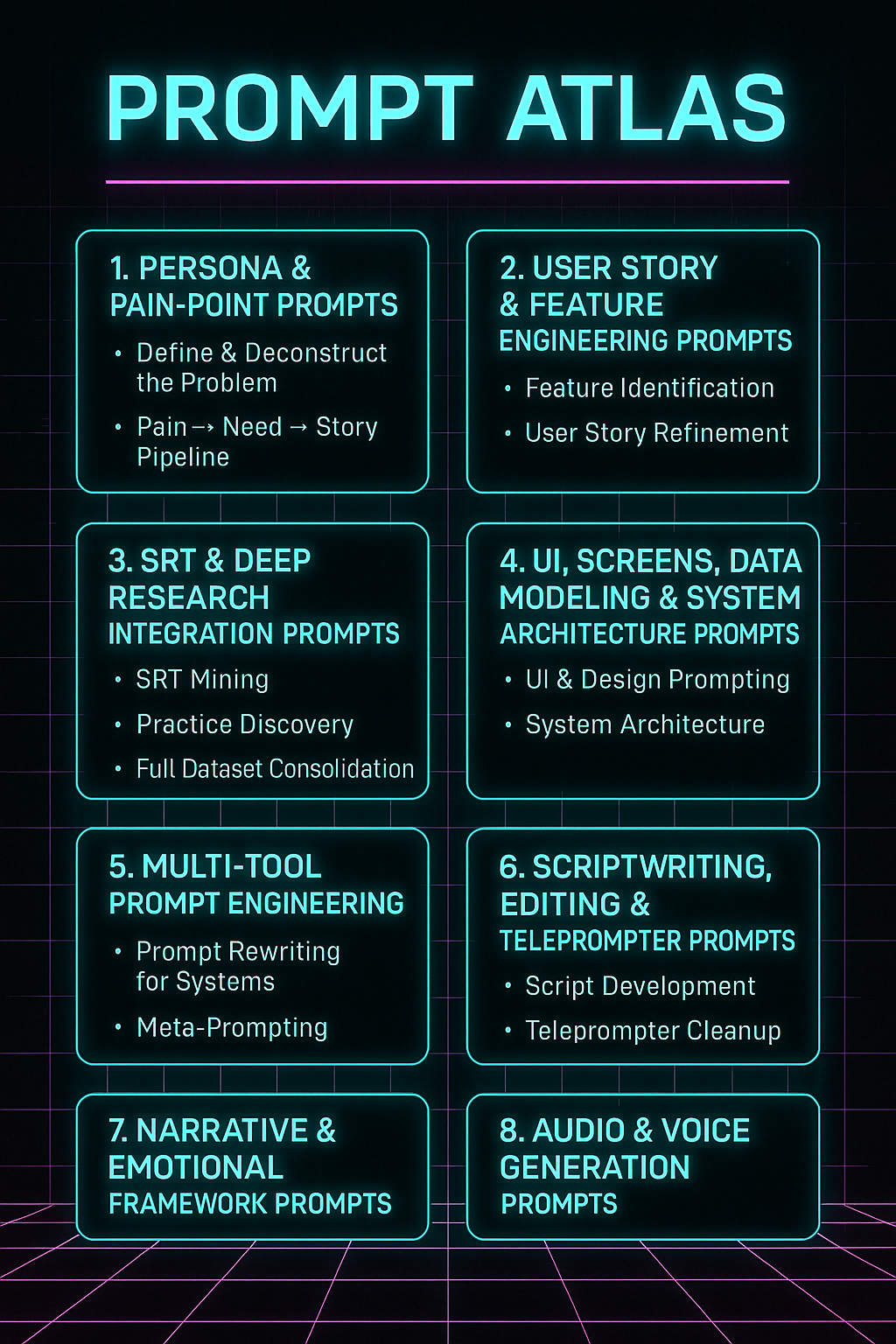
Following are the key things you will be able to do after you watch this demo:
Introduction to MVP and Ecosystem Mapping (0:00:09)
Josh introduces the concept of the Minimum Viable Product (MVP), emphasizing the importance of defining pain points, needs, and features for different stakeholders and mapping the overall project ecosystem
Three-Part Agile User Story Process (0:00:09)
Josh outlines a sequential framework: converting pains into needs and then into features, which are written as Agile user stories, highlighting the value of progressing step-by-step rather than jumping directly to user stories.
Business Vision Planning and Personas (0:08:36)
The importance of developing user personas is discussed, showing how various archetypes (e.g., medical doctors, programmers, teachers) help clarify specific needs by associating real-life pains and developing empathy-driven solutions.
Pain, Need, and Feature Transformation (0:18:15)
Demonstrates, with the example of a medical doctor, how individual pains are rewritten into user needs and further translated into actionable features, using empathetic design as a core principle.
Manual and AI-Assisted User Story Generation (0:27:50)
Josh explains how manually defining the framework prepares for leveraging AI tools, which accelerate the process of drafting needs and Agile user stories for each persona.
Leveraging AI for Brainstorming and Data Mining (0:37:51)
Describes incorporating AI chatbots (e.g., ChatGPT, Gemini) to quickly generate, format, and expand user stories and pain points, as well as methods for data mining common user problems using AI.
Persona and Backlog Development Workflow (0:47:00)
Shares how organizing and summarizing ideas with AI and mind mapping tools streamlines persona development and backlog creation, allowing for comprehensive project planning and smoother team collaboration.
Iterative Process and Documentation Completion (0:55:56)
Details the ongoing, iterative approach of developing user personas and scenarios, curating and refining user stories, and documenting all features in structured formats for future product development steps.